
 Neil Nadder
We may earn a commission when you buy through our links, at no extra cost to you. As an Amazon Associate, we earn from qualifying purchases. Learn more
Short answer: “Impact drill” usually means an impact driver, which drives screws and bolts with quick rotational bursts. A hammer drill drills holes in brick and concrete by pulsing the bit forward. If you do both jobs, buy a combo kit: our top pick, the DeWalt DCK2101QQ2, includes one of each.
You’re really choosing between three tools: the regular drill/driver, the impact driver and the hammer drill. They look alike and can share batteries, but pick the wrong one and you strip screws or stall in masonry. Below we explain the differences, then recommend five picks on Amazon. Two are sold by Amazon and three by third-party sellers, which we flag on each pick.
- Best overall → DeWalt DCK2101QQ2 — hammer drill + impact driver, 2 XR batteries, up to 275 holes per charge
- Best non-DeWalt combo → Makita XT297T — hammer driver-drill + 4-speed impact driver, 2 × 5.0Ah batteries
- Best budget combo → DeWalt DCK240C2 — compact drill/driver + impact driver, no hammer mode, 2 batteries
- Best hammer drill → DeWalt DCD1007B — 3-speed brushless, 2,100 in-lbs max torque, tool only
- Best impact driver → DeWalt DCF845B — 3-speed brushless, 1,825 in-lbs, tool only
Not sure? If you’ll drill brick or concrete even once a year and also drive screws, buy the DCK2101QQ2, or the Makita XT297T if you prefer Makita. If you only build with wood and deck screws, the DCK240C2 covers it for less.
Prices and availability change often. Check Amazon for the current price.
Impact drill vs hammer drill: the difference at a glance
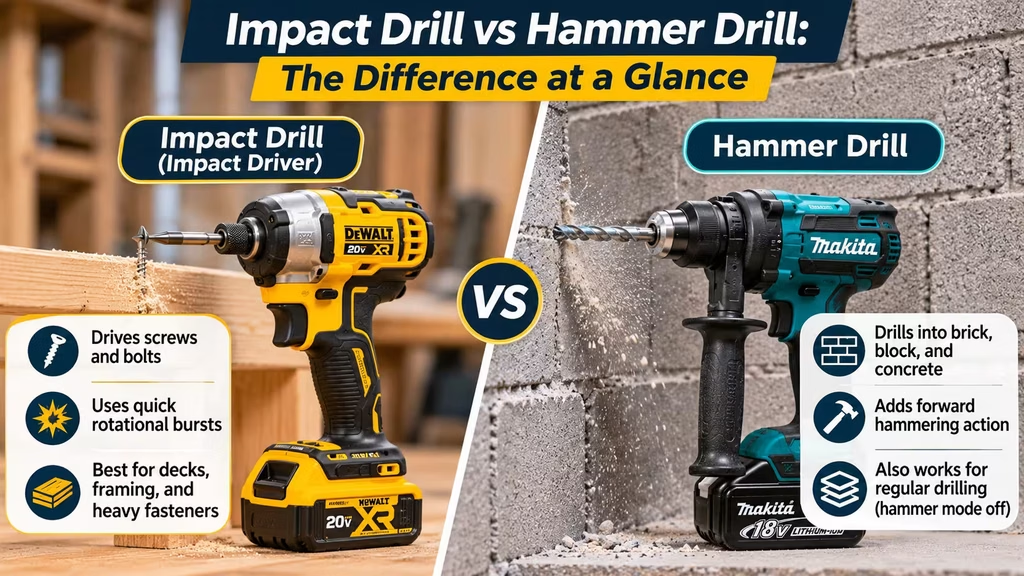
An impact driver drives fasteners, a hammer drill drills masonry, and a regular drill/driver does lighter versions of both.
| Feature | Drill/driver | Impact driver | Hammer drill |
|---|---|---|---|
| What it does | Steady rotation for drilling and driving | Rotational bursts for driving | Rotation plus forward hammering |
| Best for | General drilling, light screws | Decks, framing, lag bolts | Brick, block, concrete, plus regular drilling |
| Bit holder | Chuck, round or hex bits | 1/4-inch hex only | Chuck, round or hex bits |
| Clutch | Yes | No | Yes |
| Masonry | No | Not recommended | Yes, with carbide masonry bits |
| Our pick | Included in the DCK240C2 | DeWalt DCF845B | DeWalt DCD1007B |
Drill vs driver vs hammer drill: what each tool does
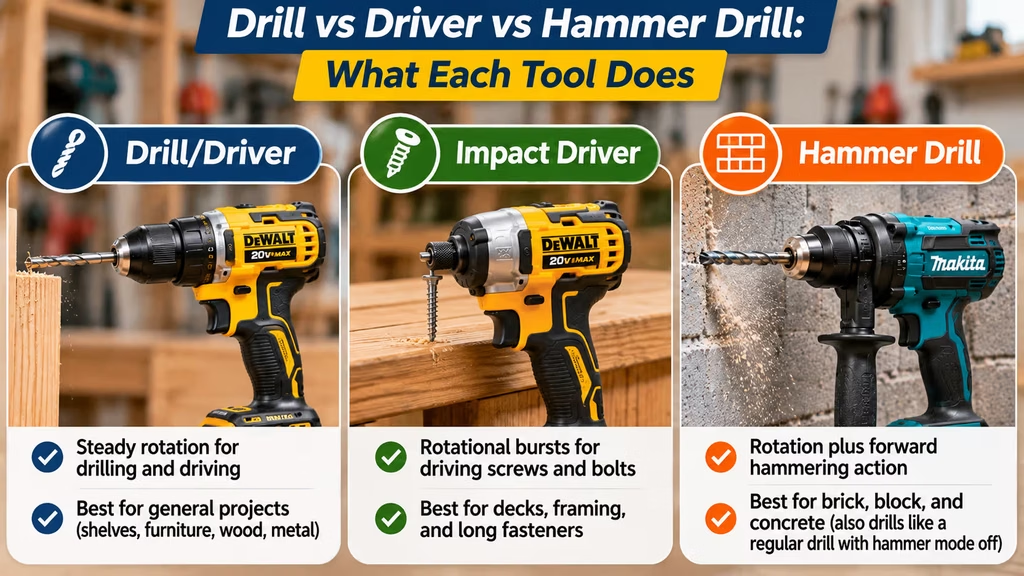
- Drill/driver: spins the bit at a steady speed, and a clutch stops screws sinking too deep. It’s the general-purpose first tool for shelves, furniture, wood, metal and drywall, but it can’t drill masonry.
- Impact driver: adds rotational hammering when resistance rises, so long screws and lag bolts go in without leaning on the tool. It takes only 1/4-inch hex bits, so it’s poor at drilling large holes.
- Hammer drill: a drill with a second mode that adds fast back-and-forth hammering. With a carbide masonry bit it drills brick, block and concrete, and with hammer mode off it works like a normal drill. It can do everything a regular drill does, at the cost of extra size and weight.
What testing shows about the differences
We don’t test tools ourselves, but Pro Tool Reviews compared a hammer drill and an impact driver (different brands from our picks):
- Noise: the impact driver measured 100 dB indoors, against 88 dB for the drill.
- Bits: the impact driver takes only 1/4-inch hex bits. The hammer drill also accepts hole saws, self-feed bits and auger bits.
- Speed: the impact driver was about 1.5 seconds faster through a 1/2-inch twist bit, the hammer drill led with a 1-inch spade bit, and the two tied on a 1/4-inch concrete bit.
3/8-inch vs 1/2-inch drill
The number is the largest bit shank the chuck holds. A 3/8-inch drill is smaller and lighter, which suits shelves, furniture and small repairs. A 1/2-inch drill holds larger spade bits, auger bits and hole saws, and is usually more powerful, which suits decks, big holes and masonry. Most hammer drills, including the DeWalt DCD1007 and Makita XPH14 in our picks, have a 1/2-inch chuck.
Screw gun vs drill
A screw gun is a drywall driver with an adjustable nose cone that sets screw depth. It can’t drill holes. For a few sheets of drywall, a drill/driver with a low clutch setting or an impact driver does the job. A screw gun pays off only when you’re hanging a whole room.
Hammer drill vs rotary hammer for concrete
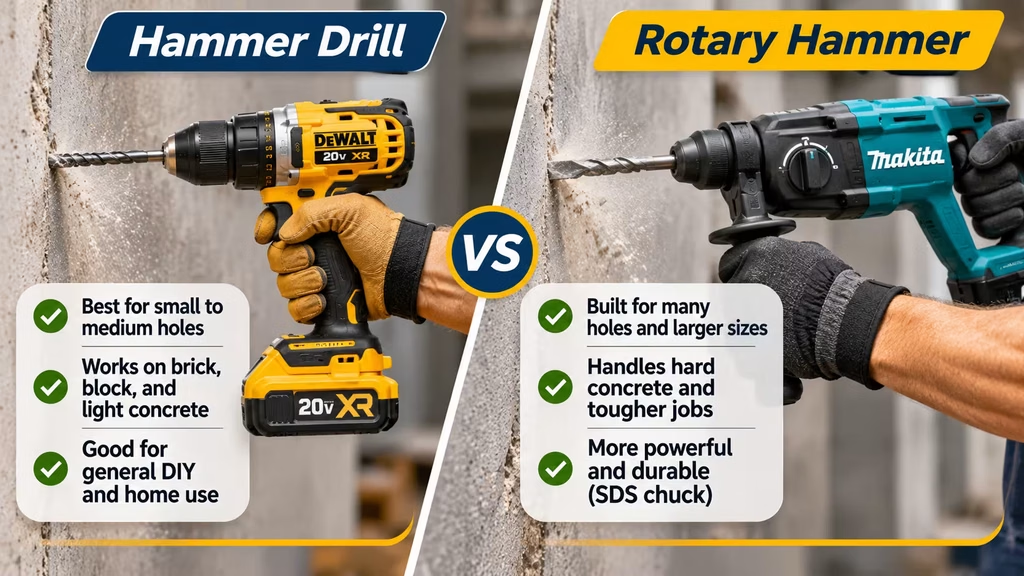
A hammer drill handles small to medium holes in brick, block and light concrete, such as mounting a bracket to a brick wall. For many holes, larger holes or heavy concrete, an SDS rotary hammer is the better tool. Impact drivers aren’t meant for drilling masonry, though they can drive screws into concrete after a pilot hole.
Which one should you buy?
- You build decks, fences or frames: an impact driver.
- You drill brick, block or concrete: a hammer drill.
- You mostly hang shelves and assemble furniture: a regular drill/driver.
- You do several of these, or you’re not sure: a combo kit.
DeWalt DCK2101QQ2: Best Overall Combo

DeWalt’s XR hammer drill (DCD1007) and impact driver (DCF845) in one kit, with two XR POWERPACK batteries, a charger and a bag.
✓ Shipped and sold by Amazon.com · Free refund/replacement
Prices and availability change often; check Amazon for the current price.
Why we picked it: It’s the only pick that covers both jobs in one box and is sold and shipped by Amazon. You get the DCD1007 hammer drill, which the listing calls DeWalt’s most powerful, plus the DCF845 impact driver, two 4Ah XR POWERPACK batteries, a charger and a bag. The listing claims up to 275 holes per charge.
Key specs:
| Spec | Detail |
|---|---|
| Hammer drill | DCD1007, brushless, 3-speed (0-450 / 1,200 / 2,000 RPM) |
| Hammer drill max torque | 2,100 in-lbs (DeWalt) |
| Anti-rotation | Shuts the drill off if the bit binds |
| Impact driver | DCF845, brushless, 3-speed, 1,825 in-lbs |
| Batteries | 2 × 20V MAX XR POWERPACK 4Ah (DCB2104) |
| Included | Charger, side handle, 2 belt hooks and kit bag |
Common praise and complaints: Reviewers praise the hammer drill’s speed, its three-speed gearbox and its kickback control, and the impact driver beat DeWalt’s older models in screw tests. The common complaints are that the hammer drill is heavier and wider than older DeWalt models and that the kit costs more than a basic combo.
Pros
- Hammer drill and impact driver in one kit
- Two batteries and charger included
Cons
- Costs more than a basic combo
- Hammer drill is heavier and wider than older models
Who it’s for, and who should skip it: Best for homeowners who drill masonry and also build decks, fences and furniture. Skip it if you only drive screws in wood.
Makita XT297T: Best Non-DeWalt Combo

Makita’s brushless XPH14Z hammer driver-drill and XDT20Z four-speed impact driver, with two 5.0Ah batteries, a rapid charger and a tool bag.
✓ Shipped and sold by a third-party seller · Check the listing for return terms
Prices and availability change often; check Amazon for the current price.
Why we picked it: It’s the best alternative if you’d rather not buy DeWalt. The kit pairs Makita’s XPH14Z brushless hammer driver-drill with the XDT20Z four-speed impact driver, two 5.0Ah batteries, a rapid charger and a bag. The drill weighs about 6 lb with a battery. This listing is sold by a third-party seller, so check the seller details and return terms.
Key specs:
| Spec | Detail |
|---|---|
| Hammer driver-drill | XPH14Z, brushless, 2-speed (0-550 / 0-2,100 RPM) |
| Drill max torque | 1,250 in-lbs |
| Impact driver | XDT20Z, brushless, 4-speed, 1,590 in-lbs |
| Impact driver extras | Assist mode for screws, tightening modes for self-drilling screws |
| Batteries | 2 × 18V LXT 5.0Ah (BL1850B) |
| Warranty | 3-year limited (Makita) |
Common praise and complaints: Reviewers praise the drill’s speed on high, the compact bodies and the impact driver’s light ring and assist mode. The common complaints are that the drill’s torque is below DeWalt’s top model and that its low speed is slow in thick material.
Pros
- Hammer drill and four-speed impact driver in one kit
- Two 5.0Ah batteries and a charger included
Cons
- Lower drill torque than DeWalt’s DCD1007
- Sold by a third-party seller
Who it’s for, and who should skip it: Best for homeowners who prefer Makita or already own Makita 18V batteries. Skip it if you want maximum torque for large masonry holes.
DeWalt DCK240C2: Best Budget Combo

A compact drill/driver and impact driver with built-in LED lights, two batteries, a charger and a bag. No hammer mode.
✓ Shipped and sold by Amazon.com · DeWalt approved · Free refund/replacement
Prices and availability change often; check Amazon for the current price.
Why we picked it: It’s a low-cost way to get both a drill/driver and an impact driver from a brand with a deep battery lineup. Both tools are compact, with built-in LED lights, and the kit includes two batteries, a charger and a bag. It has no hammer mode, so it’s for wood, drywall and metal, not masonry.
Key specs:
| Spec | Detail |
|---|---|
| Tools | DCD771 1/2-inch drill/driver and DCF885 1/4-inch impact driver |
| Platform | 20V MAX |
| Hammer mode | No |
| Batteries | 2 × 1.3Ah 20V MAX lithium-ion |
| Warranty | 3-year limited (DeWalt) |
| Seller | Shipped and sold by Amazon.com, DeWalt approved |
Common praise and complaints: Reviewers praise the value, the compact size and how well the pair handles household jobs. The common complaints are the small batteries, a drill chuck that can feel loose, and tools that aren’t built for heavy daily use.
Pros
- Low-cost way to get two tools and a battery set
- Compact tools fit tight spaces
Cons
- No hammer mode, so no masonry
- Small batteries limit runtime
Who it’s for, and who should skip it: A good fit for first-time buyers and anyone building with wood and drywall. Skip it if you plan to drill brick or concrete.
DeWalt DCD1007B: Best Hammer Drill

A 3-speed brushless hammer drill with automatic anti-rotation and 2,100 in-lbs of max torque. Sold tool only, so you need a 20V MAX battery.
✓ Sold by a third-party seller · Check the listing for return terms
Prices and availability change often; check Amazon for the current price.
Why we picked it: It’s the strongest drill in this guide for masonry, with 2,100 in-lbs of max torque, three speeds and an anti-rotation system that shuts the drill off if the bit binds. It’s tool only, so you need a 20V MAX battery. This listing is sold by a third-party seller, so check the seller details and return terms.
Key specs:
| Spec | Detail |
|---|---|
| Type | 1/2-inch brushless hammer drill, 20V MAX XR |
| Max torque | 2,100 in-lbs (listing) |
| Speeds | 3 (0-450 / 1,200 / 2,000 RPM) |
| Weight | 4.1 lb bare (Pro Tool Reviews) |
| Runtime claim | Up to 275 holes per charge with DeWalt’s 8Ah battery and a 7/8-inch auger bit |
| Included | Tool only, no battery or charger |
Common praise and complaints: Reviewers praise the power, the three-speed gearbox and the anti-rotation system. The common complaints are that it’s heavier and wider than older DeWalt hammer drills and that the battery and charger are extra.
Pros
- Highest torque in this guide
- Good value if you already own DeWalt batteries
Cons
- Battery and charger not included
- Sold by a third-party seller
Who it’s for, and who should skip it: Best for DeWalt owners who want a masonry-capable drill without buying a kit. Skip it if you have no 20V MAX batteries or want an impact driver too.
DeWalt DCF845B: Best Impact Driver

A compact 3-speed brushless impact driver with an LED light and 1,825 in-lbs of torque. Sold tool only, so you need a 20V MAX battery.
✓ Ships from Amazon, sold by a third-party seller · Free refund/replacement
Prices and availability change often; check Amazon for the current price.
Why we picked it: If you already own a drill, this is the tool that drives long screws and lag bolts without strain. It’s a three-speed brushless impact driver with an LED light and 1,825 in-lbs of torque. It’s tool only, so bring a 20V MAX battery. The Buy Box shows it shipping from Amazon and sold by a third-party seller.
Key specs:
| Spec | Detail |
|---|---|
| Type | 1/4-inch hex brushless impact driver, 20V MAX XR |
| Torque | 1,825 in-lbs |
| Speeds | 3 (0-1,500 / 2,800 / 3,400 RPM), 4,200 impacts per minute |
| Size | 5.1 in. long (listing), 2.0 lb bare (Pro Tool Reviews) |
| Included | Tool only, no battery or charger |
Common praise and complaints: Reviewers praise its speed, which beat DeWalt’s older XR impact drivers in screw and lag-screw tests. The common complaints are that torque is unchanged from older models, so the heaviest bolts need an impact wrench, and that the smaller DCF850 is better if size matters most.
Pros
- Fast driving speed in a compact body
- Three speeds help prevent over-driving
Cons
- Battery and charger not included
- Sold by a third-party seller
Who it’s for, and who should skip it: Best for deck builders and anyone driving long fasteners who already owns a drill and a 20V MAX battery. Skip it if you only hang pictures and assemble furniture.
How to choose a drill or driver
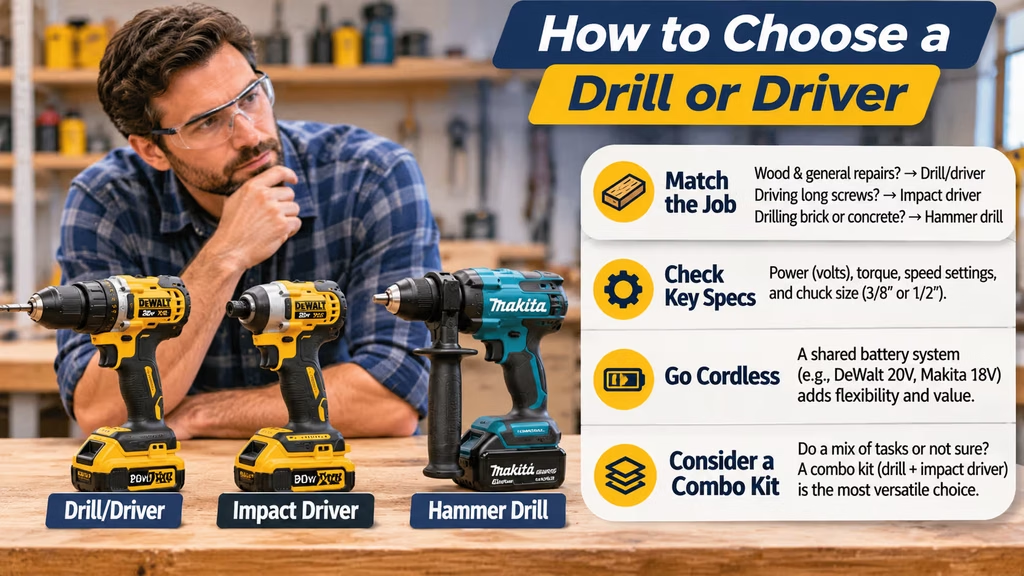
- Torque: more helps with large fasteners and big holes, but check the number of speeds too.
- Brushless motor: runs cooler and tends to last longer. The DCK2101QQ2, XT297T, DCD1007B and DCF845B are brushless; the budget combo’s listing doesn’t say.
- Battery: tool-only listings don’t include a battery or charger, so check the platform and amp-hour rating.
- Seller: Amazon-sold items have a standard return path. For third-party listings, read the seller name and return terms.
Safety
- Wear safety glasses and hearing protection; both tools are loud in impact or hammer mode.
- Drilling concrete creates fine dust, including silica. Use dust control and a respirator rated for fine dust.
- Keep both hands on the tool for large holes; a bit can still bind.
- We searched CPSC recall notices for these models and found none. Recheck the CPSC site before you buy.
Models we left out
- DeWalt DCK277D2: Amazon lists it as the newer version of the DCK240C2. We haven’t reviewed it, so the DCK240C2 stays as our budget pick.
- Makita XT288T: we couldn’t find a live Amazon page for it, so we chose the newer XT297T.
- DeWalt DCF860B and DCD1007WW1 kit: we couldn’t find a working Amazon page for either when we checked.
Impact drill vs hammer drill FAQ
Is an impact drill the same as an impact driver?
Usually, yes. Impact drivers drive screws and bolts with rotational bursts and take 1/4-inch hex bits. Some retailers outside the US use “impact drill” for a hammer drill, so check for a hammer-mode switch.
What’s the difference between a drill and a driver?
A drill spins the bit steadily, while an impact driver adds rotational bursts. A drill/driver has a clutch and a chuck for round or hex bits, and an impact driver is built for long fasteners.
Can a hammer drill be used as a regular drill?
Yes. Turn hammer mode off and it works like a normal drill in wood, metal and plastic, and it can drive screws using its clutch. It’s heavier than a regular drill.
Can a hammer drill replace an impact driver?
Not really. It drives screws well with a clutch, but it lacks the impact action that keeps long fasteners from stripping.
Can an impact driver drill into concrete?
Not well. Its hammering is rotational, not forward, so it’s slow and wears bits. Use a hammer drill for concrete.
Do I need both an impact driver and a hammer drill?
Only if you do both jobs regularly. A combo kit is the cheapest way to own both.
What bits do I need?
Impact-rated hex bits for an impact driver and carbide-tipped bits for masonry. Standard twist bits work for wood and metal on either tool.
Final verdict
For most homeowners, the DeWalt DCK2101QQ2 is the right buy: it includes a hammer drill and an impact driver, and Amazon sells and ships it. If you prefer Makita, choose the XT297T. If you stick to wood and drywall, the DCK240C2 does the job for less. Already own DeWalt batteries? Add the DCD1007B for masonry or the DCF845B for fasteners, and check the seller on each, since all three are third-party listings.