

 Neil Nadder
We may earn a commission when you buy through our links, at no extra cost to you. As an Amazon Associate, we earn from qualifying purchases. Learn more
Short answer: The best reverse osmosis system for most refrigerators is the iSpring RCC7AK. Its storage tank keeps steady pressure on the fridge’s water and ice line, it needs no electricity, it adds minerals back for better-tasting water and ice, and it’s certified to NSF/ANSI 58 as a complete system. If you want a slim tankless unit instead, the Waterdrop G3P600 is the most popular choice, paired with a small pressure tank for the fridge line.
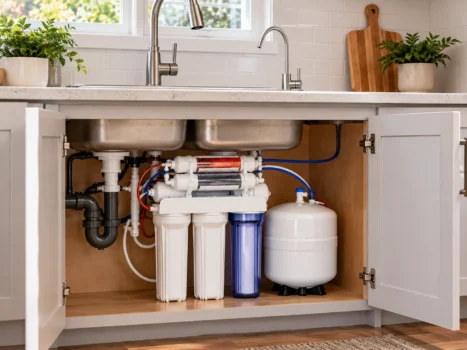
Your fridge’s built-in filter is a small carbon cartridge. It improves taste and odor, but it can’t remove dissolved solids the way reverse osmosis (RO) can. An under-sink reverse osmosis system for your refrigerator can feed its water dispenser and ice maker as well as a drinking faucet, so every glass and every ice cube comes from the same purified water.
One thing most buyers don’t realize: tankless RO systems can deliver uneven pressure to a fridge, which leads to slow dispensing or small ice cubes. This guide explains how to avoid that, and recommends five RO systems that work for refrigerator hookups, all sold on Amazon in the USA.
- Best overall → iSpring RCC7AK — tank system, remineralization, no power needed
- Best tankless value → Waterdrop G3P600 — 600 GPD, 2:1 drain ratio, slim design
- Best high-flow tankless → Waterdrop G3P800 — 800 GPD, 3:1 drain ratio, for big households
- Best tankless with remineralization → iSpring RO500AK — 500 GPD, alkaline stage, long filter life
- Best budget → APEC ROES-50 — tank system, lowest price, no power needed
Not sure? For a fridge hookup with the least hassle, choose the iSpring RCC7AK. Its tank handles ice makers and water dispensers without any add-ons.
Prices and availability change often. Check Amazon for the current price.
iSpring RCC7AK: Best Overall
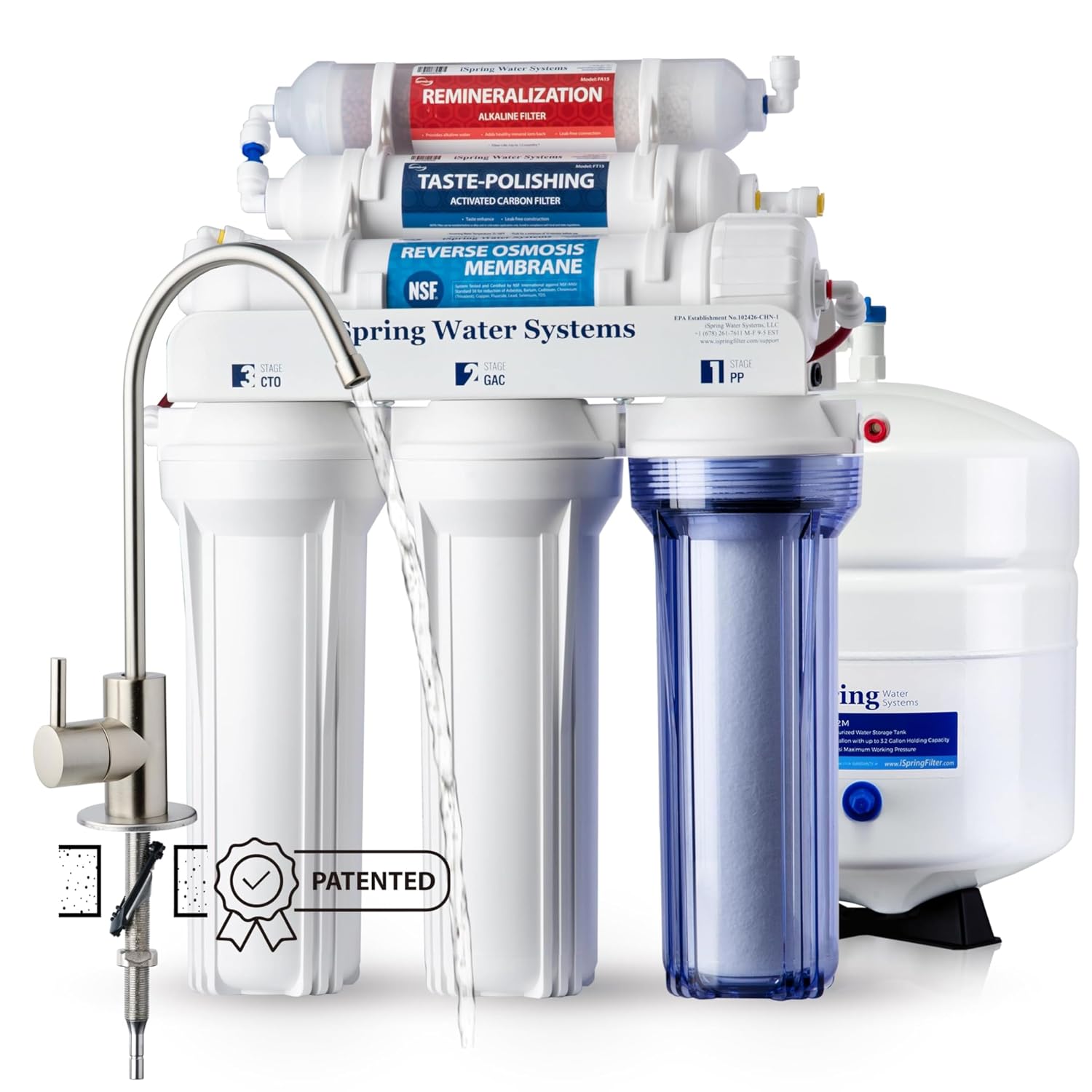
6-stage under-sink RO system with alkaline remineralization, storage tank and faucet, certified to NSF/ANSI 58.
✓ Sold and shipped by Amazon · Free 30-day returns
Prices and availability change often; check Amazon for the current price.
Why we picked it: It has the strongest track record of any RO system we considered, with more than 21,000 Amazon ratings averaging 4.6 out of 5 and a #2 rank in Under-Sink & Countertop Filtration. Its storage tank delivers steady pressure to a fridge’s ice maker and dispenser, and the sixth stage adds minerals back so water and ice don’t taste flat.
Key specs:
| Spec | Detail |
|---|---|
| Type | Tank system, 6 stages with alkaline remineralization |
| Output | 75 gallons per day |
| Certification | NSF/ANSI 58 (full system, tested by NSF International) |
| Certified reductions | Lead 98.9%, fluoride 97.4%, chromium 99.2%, TDS 97.9% |
| Power | None needed |
| Feed water | Up to 750 ppm TDS, 40-100°F |
| Filter changes | Pre-filters about every 6 months |
| In the box | RO system, brushed nickel faucet, storage tank, tool set |
| Warranty | 1 year |
What owners say: Reviewers say it’s easy to install with clear instructions, and many describe the water as better than bottled. They praise its performance and call it worth the money. The most common complaint is the faucet leaking for some owners. 84% of reviewers give it 5 stars.
Pros
- Largest review base and best rank of our picks
- Tank gives steady pressure to fridge lines without add-ons
- Remineralization for better-tasting water and ice
- No electricity needed
Cons
- The tank takes up cabinet space
- Some owners report faucet leaks
- Lower daily output than tankless picks
Who it’s for, and who should skip it: The right choice for most homes that want RO water at the sink, the fridge and the ice maker. Skip it if your under-sink cabinet is cramped; a tankless pick takes less room.
Waterdrop G3P600: Best Tankless Value
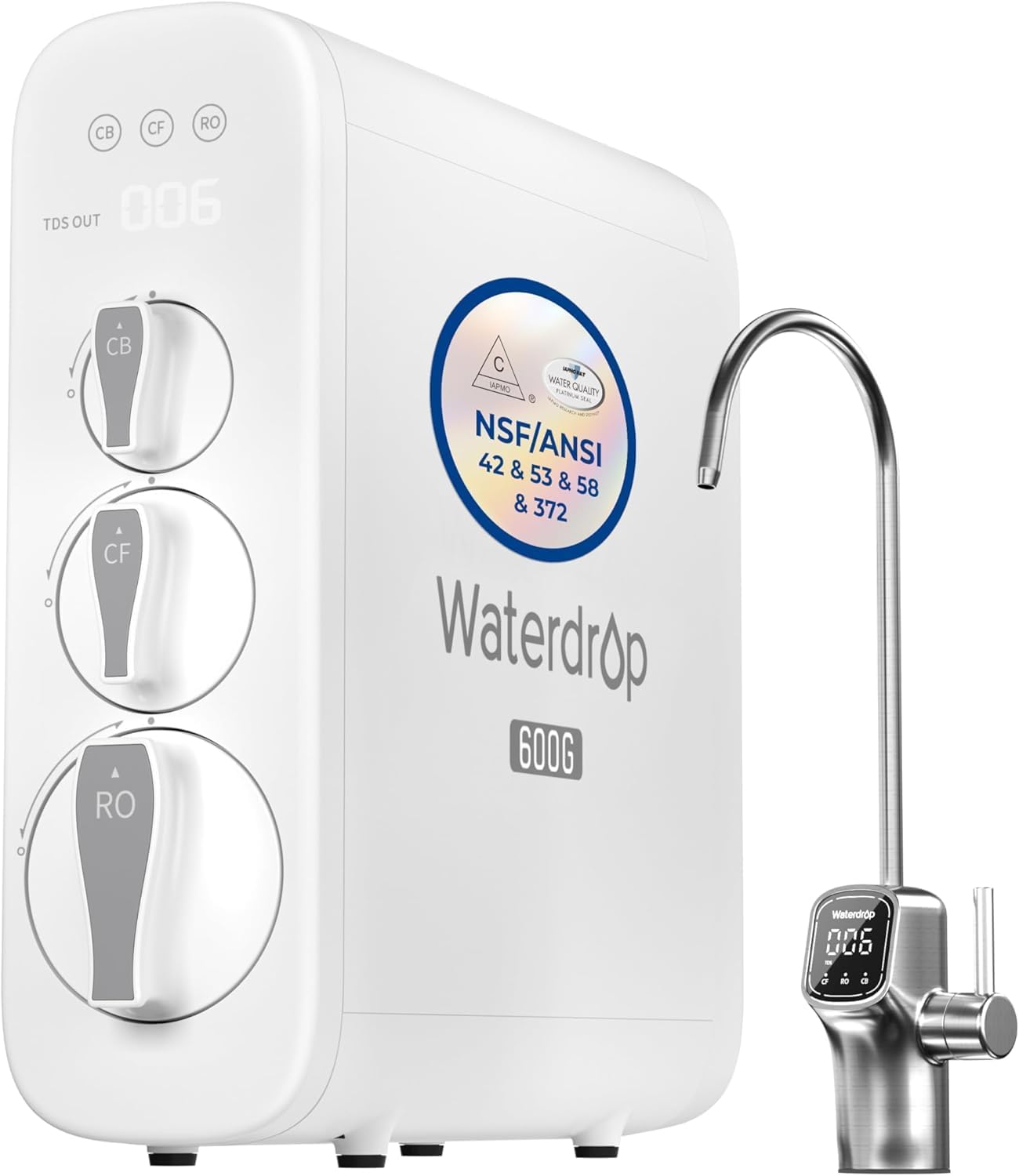
Slim 8-stage tankless RO system with 600 GPD output, smart display faucet and NSF/ANSI 42, 53, 58 and 372 certifications.
✓ Ships from Amazon, sold by Waterdrop · Free 30-day returns
Prices and availability change often; check Amazon for the current price.
Why we picked it: It’s the most popular tankless RO system we found, with more than 2,000 bought on Amazon in the past month and over 4,000 ratings averaging 4.5 out of 5. It fits in a slim cabinet, has a 2:1 drain ratio, more efficient than many traditional RO systems, and carries four NSF/ANSI certifications.
Key specs:
| Spec | Detail |
|---|---|
| Type | Tankless, 8 stages |
| Output | 600 gallons per day, about 0.42 GPM |
| Drain ratio | 2:1 (2 gallons purified per 1 to the drain) |
| Certification | NSF/ANSI 42, 53, 58 and 372 |
| Power | Needs an outlet under the sink |
| Feed water | Up to 1,500 ppm TDS, 41-100°F |
| Faucet | Smart display faucet with filter-life indicator |
| Warranty | 1 year |
What owners say: Owners praise the water quality and taste, and like how little cabinet space it takes. Flow and noise get mixed feedback: some find the flow slow or hear the pump, others find it quiet. Value is split, with some saying it pays for itself within a year, and some report leaks inside the unit. 79% of reviewers give it 5 stars and 7% give it 1 star.
Pros
- Most popular tankless pick, with a large review base
- Compact design for small cabinets
- 2:1 drain ratio and four NSF/ANSI certifications
Cons
- Needs a small pressure tank for best fridge performance
- Needs an outlet under the sink
- Some owners report slow flow or leaks
Who it’s for, and who should skip it: Best for homes with limited cabinet space that want fast, efficient RO water. For the fridge line, add Waterdrop’s small WD-PMT pressure tank. Skip it if you don’t have an outlet under the sink.
Waterdrop G3P800: Best High-Flow Tankless

10-stage tankless RO system with 800 GPD output, 3:1 drain ratio and a smart LED faucet.
✓ Ships from Amazon, sold by Waterdrop · Free 30-day returns
Prices and availability change often; check Amazon for the current price.
Why we picked it: It produces the most water of any pick, 800 gallons per day, with the most efficient 3:1 drain ratio, which suits large households that run the fridge, ice maker and drinking faucet heavily. It carries the same four NSF/ANSI certifications as the G3P600.
Key specs:
| Spec | Detail |
|---|---|
| Type | Tankless, 10 stages |
| Output | 800 gallons per day |
| Drain ratio | 3:1, the most efficient of our picks |
| Certification | NSF/ANSI 42, 53, 58 and 372 |
| Power | Needs an outlet under the sink |
| Feed water | Up to 500 ppm TDS, 41-100°F |
| Faucet | Smart LED faucet |
| Warranty | 1 year |
What owners say: Reviewers say it’s easy to install and praise the taste, water quality and fast, smooth flow. Noise gets mixed feedback. The biggest concern is reliability, with several reports of pump failures or the whole system stopping, plus some leaks at the smart faucet and complaints about filter costs over time. 80% of reviewers give it 5 stars and 8% give it 1 star.
Pros
- Highest output (800 GPD) for busy households
- Most efficient 3:1 drain ratio
- Four NSF/ANSI certifications
Cons
- Most expensive pick
- Some owners report pump failures and faucet leaks
- Needs a small pressure tank for fridge lines
Who it’s for, and who should skip it: Best for large households that use a lot of RO water at the sink and fridge. Add the WD-PMT pressure tank for the fridge connection. Skip it if your incoming water is above 500 ppm TDS or you want the most proven system for the money.
iSpring RO500AK: Best Tankless with Remineralization

Compact tankless RO system with an alkaline remineralization stage, 500 GPD output and filter reminder lights.
✓ Sold and shipped by Amazon · Free 30-day returns
Prices and availability change often; check Amazon for the current price.
Why we picked it: It combines tankless convenience with an alkaline remineralization stage, so you get compact, fast RO water that doesn’t taste flat. Its filter pack is rated for up to two years, and it’s rated 4.6 out of 5 by nearly 1,600 Amazon customers.
Key specs:
| Spec | Detail |
|---|---|
| Type | Tankless, 3 stages including carbon alkaline remineralization |
| Output | 500 gallons per day, about 0.4 GPM |
| Drain ratio | 2:1 |
| Certification | NSF/ANSI 58 (full system) |
| Power | Needs an outlet under the sink |
| Feed water | 15-70 psi, up to 1,000 ppm TDS, 41-100°F |
| Features | Auto flush, filter reminder lights |
| Warranty | 1 year |
What owners say: Owners say it’s easy to install and maintain, fits neatly under the sink and makes great-tasting water; one reports TDS dropping from the 180s to under 15. Reliability and flow get mixed feedback, with some owners reporting it stopped working or flowed slower than expected. Noise is also mixed.
Pros
- Tankless and remineralization in one unit
- Long filter life, up to two years for the full filter pack
- Quarter-turn filter changes with reminder lights
Cons
- Some owners report it stopped working or flowed slowly
- Needs an outlet and a small pressure tank for best fridge performance
- Fewer reviews than the other picks
Who it’s for, and who should skip it: Best for readers who want a compact tankless system and better-tasting water without adding a separate mineral filter. Skip it if you’d rather have a no-power tank system for the fridge line.
APEC ROES-50: Best Budget

5-stage under-sink RO system with storage tank, certified to NSF/ANSI 58 and 372, with no electricity required.
✓ Sold and shipped by Amazon · Free 30-day returns
Prices and availability change often; check Amazon for the current price.
Why we picked it: It’s the most affordable pick and still one of the most trusted, with about 9,400 Amazon ratings averaging 4.5 out of 5 and a #5 rank in its category. Like the iSpring RCC7AK, it’s a tank system that needs no electricity and gives steady pressure to a fridge line, and it handles water with the most dissolved solids of any pick (up to 2,000 ppm TDS).
Key specs:
| Spec | Detail |
|---|---|
| Type | Tank system, 5 stages |
| Output | 50 gallons per day |
| Certification | NSF/ANSI 58 and 372 |
| Power | None needed |
| Feed water | 40-85 psi, up to 2,000 ppm TDS, 40-100°F |
| Filter changes | Pre-filters about every 6 months |
| In the box | RO system, tank, filter set, manual |
| Warranty | See APEC’s warranty terms |
What owners say: Reviewers say it’s easy to install with clear, detailed instructions, and that the water tastes great and is cleaner than bottled. Many say it saves money on bottled water, and one owner reports hardness dropping from 600 to 25 ppm. Some report durability issues over time, especially plastic filter housings cracking. 79% of reviewers give it 5 stars and 7% give it 1 star.
Pros
- Lowest price of our picks
- No electricity needed and steady tank pressure for fridge lines
- Handles water with the most dissolved solids (up to 2,000 ppm TDS)
Cons
- No remineralization stage
- Lowest output (50 GPD)
- Some owners report cracked filter housings over time
Who it’s for, and who should skip it: Best for budget buyers, homes with high-TDS water, and kitchens without an outlet under the sink. Skip it if you want remineralized water; the iSpring RCC7AK adds that for a little more.
Side-by-Side Comparison
| iSpring RCC7AK | Waterdrop G3P600 | Waterdrop G3P800 | iSpring RO500AK | APEC ROES-50 | |
|---|---|---|---|---|---|
| Type | Tank | Tankless | Tankless | Tankless | Tank |
| Output | 75 GPD | 600 GPD | 800 GPD | 500 GPD | 50 GPD |
| Drain ratio | Not listed | 2:1 | 3:1 | 2:1 | Not listed |
| Remineralization | Yes | No | No | Yes | No |
| Power needed | No | Yes | Yes | Yes | No |
| NSF/ANSI 58 | Yes | Yes | Yes | Yes | Yes |
| Max feed TDS (per Amazon listing) | 750 ppm | 1,500 ppm | 500 ppm | 1,000 ppm | 2,000 ppm |
| Fridge line | Ready (tank) | Add small pressure tank | Add small pressure tank | Add small pressure tank | Ready (tank) |
| Warranty | 1 year | 1 year | 1 year | 1 year | See APEC |
| Returns on Amazon | 30 days | 30 days | 30 days | 30 days | 30 days |
Which One Should You Buy? Quick Decision Guide
- Easiest fridge hookup, best-tasting water and ice → iSpring RCC7AK
- Small cabinet, best tankless value → Waterdrop G3P600
- Large household, highest output → Waterdrop G3P800
- Tankless with minerals added back → iSpring RO500AK
- Tight budget, high-TDS water or no outlet under the sink → APEC ROES-50
Buying Guide: How to Choose an RO System for Your Refrigerator
Tank vs. tankless for a fridge
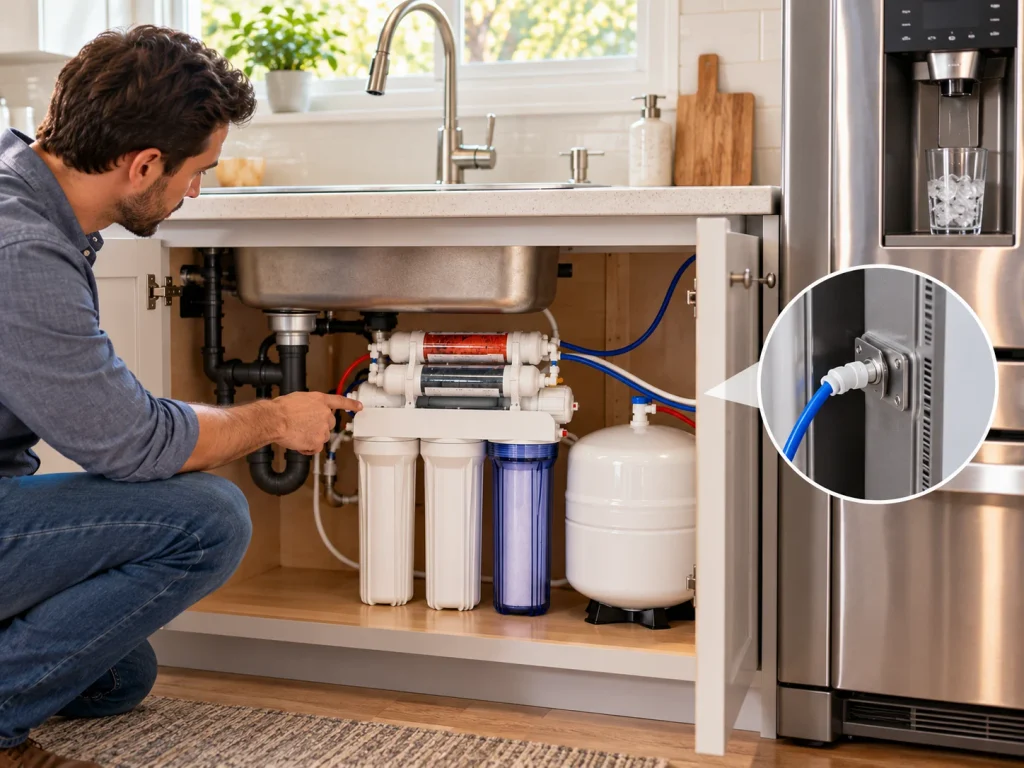
This is the most important choice for a refrigerator hookup. Tank systems store purified water under pressure, so the fridge’s ice maker and dispenser get a steady supply on demand. Tankless systems purify water as it’s needed using an electric pump. They’re compact and fast at the sink, but many fridges and ice makers draw water in short bursts, which can cause pulsing flow or slow fills. Waterdrop recommends adding its small WD-PMT pressure tank when connecting a tankless system to a refrigerator or ice maker, especially over long tubing runs.
How to connect an RO system to your fridge
Most RO systems use standard 1/4-inch tubing, so you’ll need a fridge connection kit with a tee fitting, tubing long enough to reach the fridge, and a shut-off valve. The iSpring ICEK kit works with any RO system that uses 1/4-inch tubing. Waterdrop’s pressure tank listing advises replacing the fridge’s internal filter with a bypass plug once RO water is connected, since the RO system already does the filtering and a second filter slows flow. Check your refrigerator manual before removing its filter.
Remineralization: why it matters for ice
RO removes most dissolved minerals, which can make water and ice taste flat. An alkaline remineralization stage adds a small amount of calcium and magnesium back. The iSpring RCC7AK and RO500AK include one; for the Waterdrop and APEC picks, you can add a separate mineral filter later.
Certifications to look for
- NSF/ANSI 58: the standard for reverse osmosis systems, covering TDS reduction. Every pick here is certified to it.
- NSF/ANSI 42 and 53: cover taste and odor (42) and health-related contaminants (53).
- NSF/ANSI 372: confirms lead-free materials.
Check that the certification covers the full system, not just one filter.
Output, drain ratio and water pressure
GPD (gallons per day) is how much water a system can make. A tank system’s lower GPD is fine for most families because the tank holds a reserve. Drain ratio is how much water goes down the drain for each gallon purified; tankless systems like the Waterdrops are usually more efficient. Check your home’s water pressure and hardness against each system’s supported range, since RO membranes need enough pressure to work well.
Power and installation
Tankless systems need an electrical outlet under the sink; tank systems don’t. Most RO systems are DIY installs that take a few hours and may require drilling a hole for the faucet. If you’re not comfortable working with plumbing, hire a plumber, especially for the fridge line.
Filter costs and maintenance
Budget for replacement filters. Pre-filters on tank systems are typically changed about every six months, while tankless composite filters often last a year or more. Follow each manufacturer’s schedule, since old filters reduce flow and performance.
Returns
All five picks are returnable within 30 days on Amazon, which helps if a system doesn’t fit your cabinet or your fridge setup.
Models We Left Out, and Why
- Countertop RO systems: convenient for renters, but they can’t connect to a refrigerator’s water line.
- Refrigerator replacement filters: these are carbon filters, not reverse osmosis, and don’t reduce dissolved solids the same way.
- Systems without full-system NSF/ANSI 58 certification: we only recommend RO systems certified as a complete system for TDS reduction.
Reverse Osmosis for Refrigerator FAQ
Can you connect a reverse osmosis system to a refrigerator?
Yes. Most under-sink RO systems use 1/4-inch tubing, so a fridge connection kit with a tee fitting, tubing and a shut-off valve lets the system feed your fridge’s water dispenser and ice maker.
Do I need a tank for a reverse osmosis system connected to a fridge?
A tank helps. Tank systems give steady pressure to ice makers and dispensers. Tankless systems can work, but manufacturers like Waterdrop recommend adding a small pressure tank, such as the Waterdrop WD-PMT, for fridge connections to avoid pulsing flow or slow fills.
Does RO water make better ice?
Many owners say it does. With most dissolved solids removed, ice tends to taste cleaner. A remineralization stage keeps water and ice from tasting flat.
Should I remove my refrigerator’s water filter after installing RO?
Usually, yes, with a bypass plug. Once RO water feeds the fridge, the built-in filter is redundant and can slow flow. Many refrigerators include or sell a bypass plug; check your fridge manual first.
Does reverse osmosis waste water?
Yes, some. Every RO system sends some water to the drain. Efficient tankless systems use a 2:1 or 3:1 ratio, meaning two or three gallons purified for every one sent to the drain.
How often do RO filters need to be changed?
It depends on the system and your water. Pre-filters on tank systems are often changed about every six months, while some tankless filter packs last a year or more. Follow the manufacturer’s schedule.
Will an RO system lower water pressure at my fridge?
It can, especially with tankless systems. A storage tank or a small pressure tank keeps pressure steady at the dispenser and ice maker.
Is there a reverse osmosis filter that fits inside a refrigerator?
No. Reverse osmosis needs water pressure, a membrane and a drain line, so it can’t fit in a fridge’s filter slot. Instead, an under-sink RO system feeds the refrigerator through a 1/4-inch water line, and the fridge’s own filter is usually replaced with a bypass plug.
Does reverse osmosis remove fluoride and PFAS?
RO is one of the most effective home methods for both, but check each system’s certification. The iSpring RCC7AK is certified by NSF International to NSF/ANSI 58 for 97.4% fluoride reduction. For PFAS, look for certification or third-party test results on the specific system rather than assuming every RO unit is tested for it.
Final Verdict: The Best RO System for Your Refrigerator
Our overall pick is the iSpring RCC7AK. It has the strongest track record of any system we considered, its tank delivers steady pressure to your fridge and ice maker with no add-ons, it adds minerals back for better taste, and it doesn’t need electricity.
If cabinet space is tight, the Waterdrop G3P600 is the tankless value pick, and the Waterdrop G3P800 suits larger households that need the most water. For tankless convenience with remineralization, choose the iSpring RO500AK. And if budget matters most, the APEC ROES-50 delivers certified RO water for the lowest price.
For a smooth fridge hookup, pick up a 1/4-inch fridge connection kit, add a small pressure tank like the Waterdrop WD-PMT if you choose a tankless system, and check your fridge manual for a filter bypass plug. Browse more Air & Water guides.