

 Neil Nadder
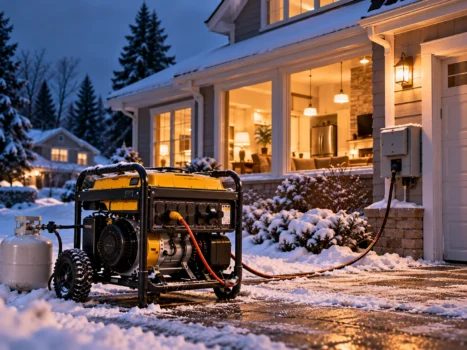
Short answer: For most homes, the best emergency generator is a dual fuel portable model with an automatic carbon monoxide (CO) shutoff and a transfer-switch-ready outlet, like the Westinghouse WGen9500DFc. If you can’t run a gas engine safely or store fuel, a large battery power station such as the EcoFlow DELTA Pro 3 is the no-fumes alternative.
When the power goes out in a winter storm, the right emergency generator keeps your furnace fan, fridge, sump pump and Wi-Fi running. The wrong one either can’t start your well pump, or puts your family at risk from carbon monoxide.
This guide recommends five generators for different homes and budgets, all sold on Amazon in the USA. Every gas pick runs on gasoline or propane and shuts itself off if CO builds up. We also explain how to size a generator, how to connect it to your home safely, and the safety rules that matter most.
- Best overall → Westinghouse WGen9500DFc — 9,500 running watts, dual fuel, CO sensor
- Best for whole-home loads → DuroMax XP13000HX — 10,500 running watts, dual fuel, 50-amp outlet
- Best budget → Westinghouse WGen5300DFc — 5,300 running watts for a fridge, sump pump and lights, dual fuel, CO sensor
- Best quiet inverter → Champion 4500W Dual Fuel Inverter — 61 dBA, clean power for electronics
- Best no-fumes battery backup → EcoFlow DELTA Pro 3 — 4,096Wh, 120/240V, no fuel or exhaust
Not sure? Most homes that want the fridge, sump pump, furnace fan and lights covered, with headroom for a window AC or microwave, are best served by the Westinghouse WGen9500DFc.
Prices and availability change often. Check Amazon for the current price.
HomeProjectBase is reader-supported. When you buy through links on our site, we may earn an affiliate commission at no extra cost to you. As an Amazon Associate, we earn from qualifying purchases. Learn more
Westinghouse WGen9500DFc: Best Overall

9,500-watt dual fuel portable generator with remote start, CO sensor and 30A/50A transfer-switch outlets.
✓ Sold and shipped by Amazon
Prices and availability change often; check Amazon for the current price.
Why we picked it: It covers what most homes need in an outage, with enough power for the fridge, freezer, sump pump, furnace fan and lights, plus a window AC or microwave, through a transfer switch. It runs on gasoline or propane, starts from a remote key fob, and shuts itself off if carbon monoxide builds up. It’s an Amazon’s Choice pick with a 4.7 out of 5 rating from nearly 800 customers.
Key specs:
| Spec | Detail |
|---|---|
| Running / starting watts (gas) | 9,500 / 12,500 |
| Running / starting watts (propane) | 8,500 / 11,200 |
| Engine | 457cc 4-stroke OHV, cast iron sleeve |
| Runtime | Up to 12 hours on a 6.6 gal tank |
| Start | Remote key fob, push-button electric, recoil backup |
| Outlets | 2 GFCI 5-20R, L14-30R and 14-50R (transfer switch ready) |
| Safety | CO sensor with automatic shutdown, low-oil shutdown |
| Weight | 212 lb |
| Warranty | 3 years limited, lifetime tech support |
What owners say: Amazon reviewers say it starts right out of the box and has enough power for whole houses and large RVs. They like the easy setup on its wheels, the intuitive control panel and the dual fuel option. Noise gets mixed feedback: some find it quieter than similar generators, others say it’s loud. 83% of reviewers give it 5 stars and 3% give it 1 star.
Pros
- Runs a fridge, sump pump, furnace fan and lights with power to spare
- Remote start, so you can start it without walking outside in a storm
- Both 30-amp and 50-amp transfer-switch outlets
Cons
- Heavy at 212 lb
- Open-frame design is louder than an inverter
- Not ideal for sensitive electronics without a surge protector, since it isn’t an inverter
Who it’s for, and who should skip it: The right choice for most single-family homes in storm-prone areas. Skip it if you need to run central AC (look at the DuroMax) or only need a fridge and a few lights (the budget pick costs much less).
DuroMax XP13000HX: Best for Whole-Home Loads
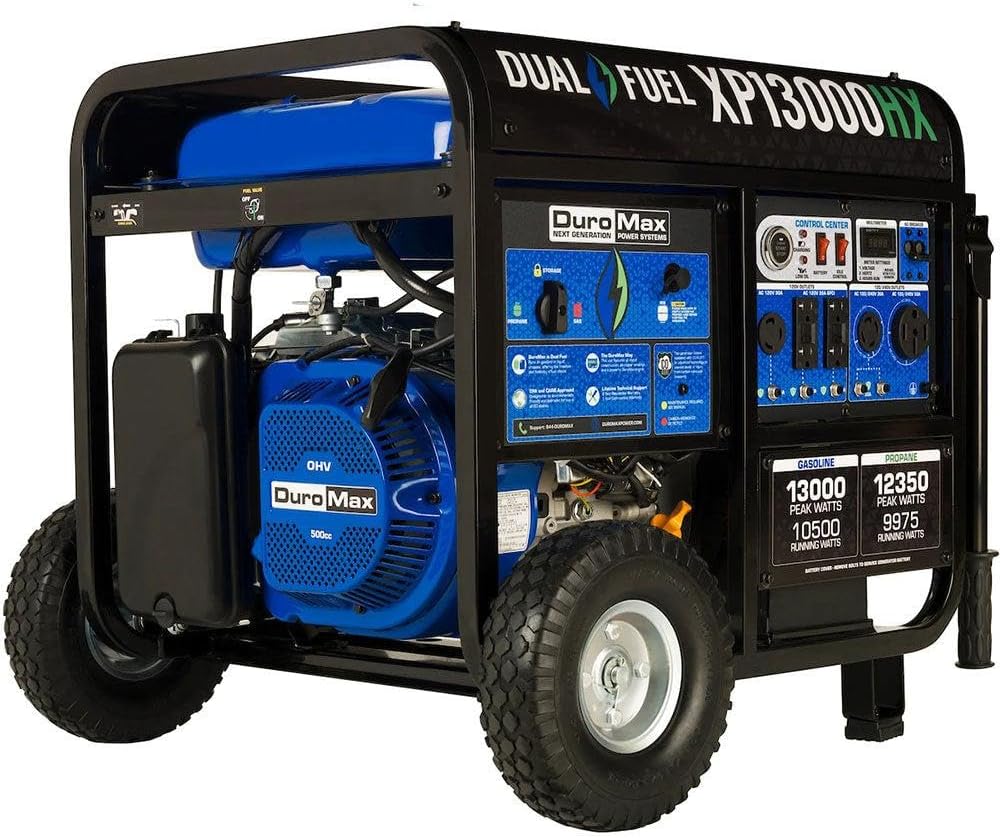
10,500-watt dual fuel portable generator with CO Alert, electric start and a 50-amp transfer-switch outlet.
✓ Sold and shipped by Amazon
Prices and availability change often; check Amazon for the current price.
Why we picked it: It has the most power of any pick here, enough for a well pump, central AC or most of a house through a 50-amp transfer switch. It’s dual fuel, has a CO Alert automatic shutoff, and comes with the longest warranty of our gas picks. It’s an Amazon’s Choice pick rated 4.5 out of 5 by more than 1,000 customers.
Key specs:
| Spec | Detail |
|---|---|
| Running / starting watts (gas) | 10,500 / 13,000 |
| Running / starting watts (propane) | 10,000 / 12,500 |
| Engine | 500cc OHV, all-copper windings |
| Runtime | 8.5 hours on gas at 50% load |
| Start | Push-button electric |
| Outlets | 4 GFCI 120V, 120V 30A, 120/240V 30A twist-lock, 120/240V 50A |
| Safety | CO Alert automatic shutdown, low-oil shutdown |
| Weight | 245 lb |
| Warranty | 5 years parts and technical service |
What owners say: Owners say it’s easy to set up, starts on the first push of the button and can power an entire house, and many call it good value compared with a permanently installed standby generator. Reliability and propane performance get mixed feedback: most say it runs well on propane, but some report it won’t restart or won’t run on propane. Noise is mixed too. 79% of reviewers give it 5 stars and 7% give it 1 star.
Pros
- Most power in this guide, with a 50-amp transfer-switch outlet
- Strong propane output (10,000 running watts)
- 5-year warranty, the longest of our gas picks
Cons
- Very heavy at 245 lb; you’ll need two people and a level path
- Some owners report starting or propane problems
- Loud open-frame engine
Who it’s for, and who should skip it: Best for larger homes, well pumps, or running central AC through a properly installed transfer switch. Skip it if you can’t store or move a 245 lb machine, or if you only need to run a fridge, sump pump and lights.
Westinghouse WGen5300DFc: Best Budget

5,300-watt dual fuel portable generator with remote start, CO sensor and a transfer-switch-ready L14-30R outlet.
✓ Sold and shipped by Amazon
Prices and availability change often; check Amazon for the current price.
Why we picked it: It’s the most affordable way to get the features that matter in an outage: dual fuel, remote electric start, a CO sensor and a transfer-switch-ready outlet. It has enough power for the fridge, freezer, sump pump, furnace fan, lights and Wi-Fi, without paying for capacity you won’t use. It’s also an Amazon’s Choice pick.
Key specs:
| Spec | Detail |
|---|---|
| Running / starting watts (gas) | 5,300 / 6,600 |
| Running / starting watts (propane) | 4,800 / 5,900 |
| Engine | 274cc 4-stroke OHV, cast iron sleeve |
| Runtime | Up to 14.5 hours on a 4.7 gal tank |
| Start | Remote key fob, push-button electric, recoil backup |
| Outlets | L14-30R (transfer switch ready), 30A RV outlet, GFCI household outlets, 120/240V selector |
| Safety | CO sensor with automatic shutdown, low-oil shutdown |
| Weight | 135.6 lb |
| Warranty | 3 years limited, lifetime tech support |
What owners say: Reviewers say it performs well with plenty of power for its size, and they like the dual fuel option, the quiet operation for its class and the remote start. Starting reliability is mixed: some units fail to start on a second try, and some owners find the starter battery weak. Value for money gets mixed feedback as well. It’s rated 4.1 out of 5 by 236 customers (61% 5 stars, 14% 1 star), the lowest score of our picks.
Pros
- Lowest price of our gas picks
- Remote start, dual fuel and CO sensor at a budget price
- Much lighter and easier to store than the larger picks
Cons
- Some owners report starting problems and a weak starter battery
- Not enough power for central AC or larger well pumps
- Lowest owner rating in this guide
Who it’s for, and who should skip it: Good for homes that only need a fridge, freezer, sump pump and lights during an outage. Keep the starter battery charged and test-run it once a month. Skip it if you want to run central AC, an electric water heater or a deep well pump.
Champion 4500W Dual Fuel Inverter: Best Quiet Inverter

Quiet 3,500-watt dual fuel inverter generator with electric start, CO Shield and clean power for electronics.
✓ Sold and shipped by Amazon
Prices and availability change often; check Amazon for the current price.
Why we picked it: Inverter generators make clean, stable power that’s safe for TVs, laptops, routers and smart-home devices, and they run much quieter than open-frame generators. At 61 dBA, this Champion is a good fit for close neighbors or anyone who wants to protect electronics. It also has CO Shield automatic shutoff and runs on propane for up to 21 hours.
Key specs:
| Spec | Detail |
|---|---|
| Running / starting watts (gas) | 3,500 / 4,500 |
| Running watts (propane) | 3,150 |
| Engine | 212cc |
| Runtime | Up to 14 hours on gas, 21 hours on propane (25% load) |
| Noise | 61 dBA |
| Start | Electric start, Cold Start Technology |
| Outlets | 120V 30A RV (TT-30R), 120V 20A duplex, 12V DC |
| Safety | CO Shield automatic shutoff |
| Weight | 99.2 lb |
| Warranty | 3 years limited, free lifetime tech support |
What owners say: Owners say it’s quiet, easy to use and worth the money, including simple oil changes. They report it starts on the first pull and runs 30-amp campers without trouble, and one owner says it ran all night on one tank in winter. 80% of reviewers give it 5 stars and 8% give it 1 star.
Pros
- Quietest gas pick (61 dBA)
- Clean power for sensitive electronics
- Long propane runtime; can be paired with a second Champion inverter for more power
Cons
- 120V only; can’t power 240V appliances or a 240V transfer switch
- Least power of our gas picks
Who it’s for, and who should skip it: Best for homes that want quiet power for a fridge, lights and electronics, for close neighbors, and for RV owners who want one generator for both. Skip it if you need a 240V well pump or want to back up circuits through a transfer switch.
EcoFlow DELTA Pro 3: Best No-Fumes Battery Backup

4,096Wh battery power station with 4,000W output and 120/240V support: no fuel, no exhaust, safe indoors.
✓ Sold by EcoFlow’s official store on Amazon
Prices and availability change often; check Amazon for the current price.
Why we picked it: A battery power station makes no exhaust, needs no fuel and runs almost silently. That makes it the right pick for renters, apartments, homes with medical devices, or anyone who can’t safely run a gas engine. It’s the only kind of backup power in this guide that’s safe to use as an in-home generator. With 4,096Wh of capacity, 4,000W of output and 240V support, it can run appliances like a well pump.
Key specs:
| Spec | Detail |
|---|---|
| Capacity | 4,096Wh LFP battery, expandable with extra batteries |
| Output | 4,000W continuous, 6,000W with X-Boost |
| Voltage | 120V and 240V |
| Outlets | 4 NEMA 5-20R, TT-30R, L14-30R, 6-20R |
| Charging | Wall outlet, solar (up to 2,600W), EV charger, generator |
| Battery life | 4,000 cycles to 80% capacity |
| Weight | About 115 lb |
| Warranty | 5 years (3 standard plus 2 with app registration) |
What owners say: Owners say it’s easy to use, quick to set up and powerful, with one reporting it ran a 5,000 BTU window AC for over 8 hours. Battery life and charging get mixed feedback: some get a full day of use and fast recharges, others report only a few hours or charging problems. Many say it’s very heavy. 76% of reviewers give it 5 stars and 10% give it 1 star.
Pros
- No exhaust or fuel, so it’s safe to use indoors
- Nearly silent operation
- Runs 240V appliances and recharges from solar
Cons
- Most expensive pick
- Runtime is limited by battery capacity during long outages unless you recharge with solar or a generator
- Heavy for a “portable” unit at about 115 lb
Who it’s for, and who should skip it: Best for apartments, renters, medical devices like CPAP machines, and solar owners. Runtime depends on what you run: a fridge and lights will last far longer than an AC. Skip it if you expect multi-day outages with no way to recharge.
Side-by-Side Comparison
| WGen9500DFc | XP13000HX | WGen5300DFc | Champion 201319 | DELTA Pro 3 | |
|---|---|---|---|---|---|
| Type | Open frame | Open frame | Open frame | Inverter | Battery |
| Running watts (gas) | 9,500 | 10,500 | 5,300 | 3,500 | 4,000 (battery) |
| Running watts (propane) | 8,500 | 10,000 | 4,800 | 3,150 | n/a |
| 240V output | Yes | Yes | Yes | No | Yes |
| 50-amp outlet | Yes | Yes | No | No | No |
| CO shutoff | Yes | Yes | Yes | Yes | Not needed |
| Noise (manufacturer) | As low as 74 dBA | Not listed | As low as 68 dBA | 61 dBA | As low as 30 dB |
| Weight | 212 lb | 245 lb | 135.6 lb | 99.2 lb | About 115 lb |
| Warranty | 3 years | 5 years | 3 years | 3 years | 5 years |
Which One Should You Buy? Quick Decision Guide
- Fridge, sump pump, furnace fan and lights, plus a window AC or microwave → Westinghouse WGen9500DFc
- Well pump, central AC or most of the house → DuroMax XP13000HX
- Fridge, sump pump, furnace fan and lights on a budget → Westinghouse WGen5300DFc
- Quiet power for electronics, close neighbors or an RV → Champion 201319
- Apartment, renter, medical device, or no safe place to run a gas engine → EcoFlow DELTA Pro 3
Buying Guide: How to Choose an Emergency Generator
How much generator do you need?
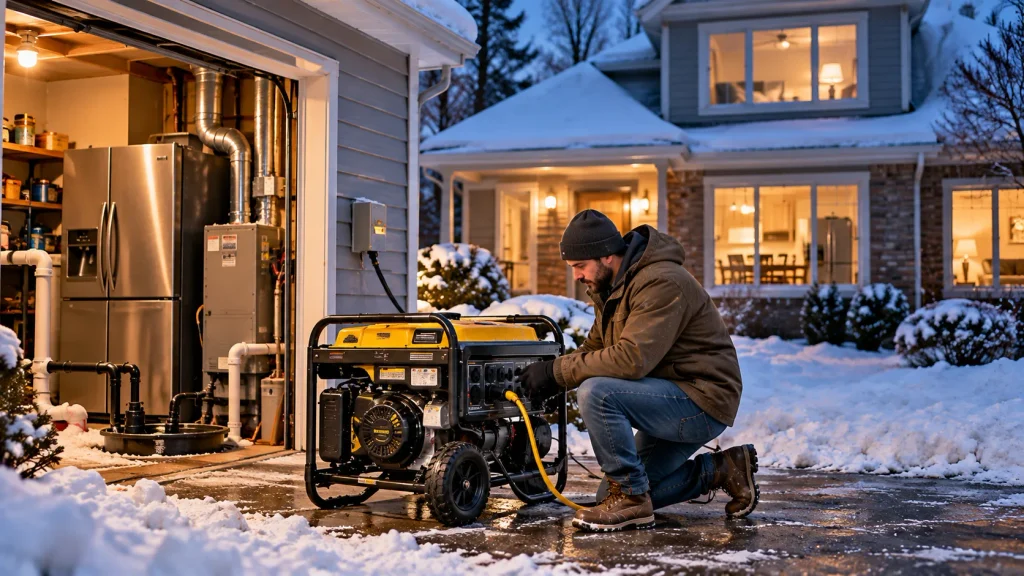
To size an emergency generator, add up the running watts of everything you want on at the same time, then make sure the generator’s starting watts can cover the largest motor starting up, such as a fridge compressor, sump pump or well pump. Motors briefly draw two to three times their running watts when they start.
Typical wattage for common outage loads, from Champion Power Equipment’s wattage reference guide:
| Appliance | Running watts | Starting watts |
|---|---|---|
| Refrigerator | 700 | 2,200 |
| Freezer (1/4 HP) | 600 | 1,200 |
| Sump pump | 800 | 2,000 |
| Furnace fan (1/2 HP) | 875 | 2,300 |
| Well pump (1 HP) | 1,900 | 5,700 |
| Window AC | 1,200 | 4,800 |
| LED lights, Wi-Fi, phone chargers | 100-300 total | Same |
Your appliances may differ, so check their labels. Central AC varies too much by size and age to list; have an electrician measure it.
Worked example: a fridge (700), sump pump (800), furnace fan (875) and lights with Wi-Fi (200) add up to 2,575 running watts. The biggest startup surge is the furnace fan, which needs 1,425 extra watts for a few seconds (2,300 minus 875). So you need about 2,575 running watts and 4,000 starting watts. The Westinghouse WGen5300DFc (5,300 running / 6,600 starting) covers that with room to spare.
- 3,000-5,500 running watts covers a fridge, freezer, sump pump, furnace fan and lights.
- 8,000-10,000 running watts adds a window AC, microwave or well pump.
- 10,000+ running watts is what you need for central AC or most of a home.
Running on propane lowers output slightly, so size by the propane rating if propane will be your main fuel.
Open frame vs. inverter vs. battery
- Open-frame generators give you the most watts per dollar and usually have 240V and transfer-switch outlets. They’re louder and their power isn’t as clean as an inverter’s.
- Inverter generators are much quieter and produce clean power that’s safe for electronics, but they cost more per watt and smaller models are 120V only.
- Battery power stations have no exhaust, no fuel and almost no noise, so they’re the only type safe to use indoors. Runtime is limited by battery capacity unless you can recharge with solar or a generator.
Why dual fuel matters
In widespread outages, gas stations often can’t pump fuel without power. A dual fuel generator also runs on propane from standard 20 lb tanks, which store for years without going stale. Running a dual fuel generator on propane for its monthly test run also helps prevent the carburetor problems that stale gasoline causes.
Features worth paying for
- Automatic CO shutoff (CO Sensor, CO Shield, CO Alert): every gas pick in this guide has one, and we won’t recommend a generator without it.
- Electric or remote start, so you aren’t pull-starting in the cold.
- Transfer-switch-ready outlet (L14-30R or 14-50R) for a safe home connection.
- Fuel gauge and hour meter for tracking fuel and maintenance.
Connecting a generator to your home: transfer switch or interlock only
To power hardwired circuits like a furnace, well pump or sump pump, have a licensed electrician install a transfer switch or an interlock kit with a power inlet box. This isolates your home from the utility grid.
Never “backfeed” a generator by plugging it into a dryer or wall outlet with a double-ended cord. Backfeeding can send power into utility lines and electrocute line workers or neighbors, can start fires, and can destroy your generator when grid power returns. It’s also illegal in many areas.
If you don’t have a transfer switch, run heavy-duty outdoor extension cords from the generator to individual appliances instead.
Keep it ready: basic maintenance
Most emergency generator failures come from neglect, not defects. To make sure yours starts when you need it:
- Test-run it monthly for 20-30 minutes under a light load. On dual fuel models, run it on propane.
- Add fuel stabilizer to stored gasoline, or run the carburetor dry before long storage.
- Change the oil after the break-in period and then on the schedule in your manual.
- Keep the starter battery charged with a battery maintainer, since electric start depends on it.
- Store a spare 20 lb propane tank and outdoor extension cords with the generator.
Returns
Every generator and power station in this guide is non-returnable on Amazon, because fuel engines and large lithium batteries ship as hazardous materials. Double-check the model, wattage and outlets you need before you buy.
Generator Safety: Carbon Monoxide Kills
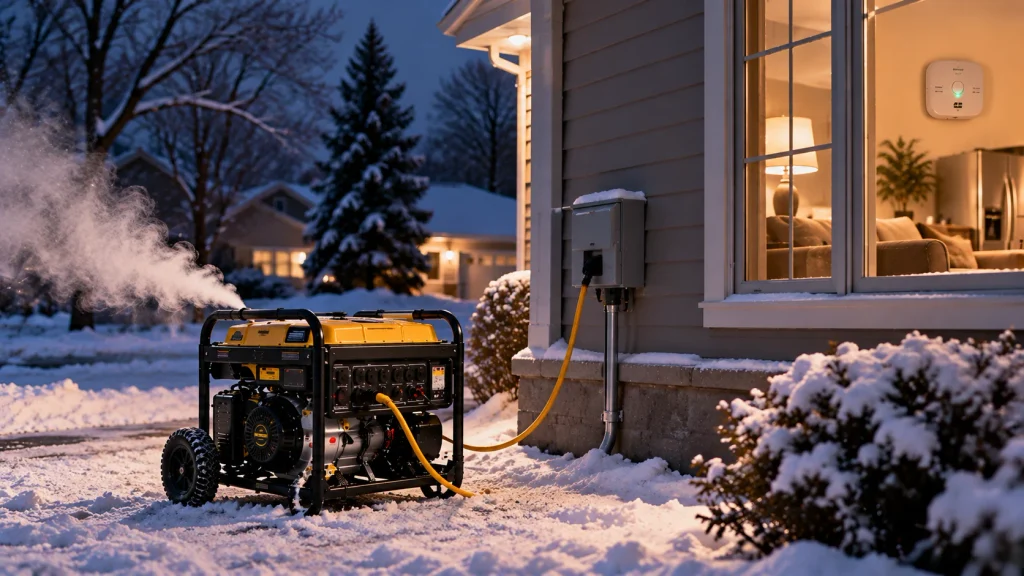
Portable generator exhaust contains carbon monoxide, an odorless, invisible gas that can kill within minutes. According to the U.S. Consumer Product Safety Commission, about 90 people die each year in the U.S. from generator-related CO poisoning (Consumer Reports). An automatic CO shutoff is a backup, not permission to break these rules:
- Run gas generators outdoors only, never inside a home, garage, basement, crawl space or shed, even with doors or windows open.
- Keep it at least 20 feet from the house, with the exhaust pointed away from doors, windows and vents. The CPSC recommends 20 feet even when a manual says less (U.S. PIRG summary of CPSC guidance).
- Install battery-powered CO alarms inside your home, on every level and outside sleeping areas.
- Get to fresh air immediately if you feel dizzy, sick or weak while a generator is running, and call 911.
- Let it cool before refueling, and store fuel away from the generator and living areas.
- Keep it dry. Use a generator cover or tent designed for running generators; never operate one in standing water.
- Never backfeed your home’s wiring (see the transfer switch section above).
- Check for recalls on any generator you own at cpsc.gov/Recalls.
Battery power stations like the EcoFlow DELTA Pro 3 produce no exhaust and can be used indoors.
Models We Left Out, and Why
- Generac portable generators: in April 2026, Generac recalled about 149,400 portable generators, including GP3600, GP6500, GP6500E, GP6500EDF, GP6700EDF, GP8000E and GP9200E models, because fuel can leak from the carburetor during the first fill (CPSC). If you own one, check your model and serial number on Generac’s recall page.
- Generators without automatic CO shutoff: including older versions of popular models, such as the Westinghouse WGen9500DF without the “c”. We don’t recommend any gas generator without one.
- Permanent standby generators: whole-house standby units are installed by electricians and plumbers with a permit, so they aren’t an Amazon purchase. They’re worth a quote if you lose power often.
- Small 2,000-2,500W inverters: great for camping, but too small to back up more than a fridge and a few lights.
Best Emergency Generator FAQ
What size generator do I need to run my house during an outage?
For a fridge, freezer, sump pump, furnace fan and lights, 3,000-5,500 running watts is usually enough. Make sure the starting watts can handle the biggest motor starting up. To add a well pump, window AC or microwave, look at 8,000-10,000 running watts, and for central AC or most of a home, 10,000 or more.
Is a dual fuel generator worth it?
Yes, for emergency backup. Gas stations often can’t pump fuel during widespread outages, while propane tanks store for years without going stale. Expect slightly lower output on propane.
Can I run a generator in my garage with the door open?
No. Carbon monoxide can build up to deadly levels in a garage even with the door open. Run gas generators outdoors only, at least 20 feet from the house with the exhaust pointed away from doors and windows.
Do I need a transfer switch for a portable generator?
You need one to power hardwired circuits like a furnace, well pump or sump pump. Have a licensed electrician install a transfer switch or interlock kit. Without one, plug appliances directly into the generator with heavy-duty outdoor extension cords, and never backfeed through a wall outlet.
Is a battery power station as good as a gas generator?
It depends on how long your outages last. A battery power station is quieter, makes no fumes and can be used indoors, but it runs only as long as its battery unless you recharge it with solar or a generator. For multi-day outages, a dual fuel generator is more practical.
What’s the difference between an inverter and a regular generator?
Inverter generators produce cleaner, more stable power and run much quieter, which makes them safer for electronics. Regular open-frame generators deliver more watts for the money and often include 240V and transfer-switch outlets.
How far should a generator be from the house?
At least 20 feet, with the exhaust pointed away from doors, windows and vents. The CPSC recommends this distance even when a generator’s manual allows less.
How long will a 20 lb propane tank run a generator?
It depends on the generator and the load. Westinghouse rates the WGen9500DFc at up to 7 hours on a 20 lb tank, while Champion rates its smaller 4500W inverter at up to 21 hours at 25% load. Keep two or three tanks on hand for a multi-day outage.
What is the best generator brand?
There’s no single best brand, but Westinghouse, Champion and DuroMax all stand out for home backup. All three offer dual fuel models with automatic CO shutoff, 3- to 5-year warranties and U.S. customer support, which is why every gas pick in this guide comes from one of them.
Final Verdict: The Best Emergency Generator for Most Homes
Our overall pick is the Westinghouse WGen9500DFc. It runs a typical home’s fridge, sump pump, furnace fan and lights with room for extras like a window AC, runs on gasoline or propane, starts by remote, includes a CO sensor, and has both 30-amp and 50-amp transfer-switch outlets.
If you need to run central AC or a well pump, step up to the DuroMax XP13000HX. For a fridge, sump pump and lights on a budget, the Westinghouse WGen5300DFc does the job. If quiet operation and clean power for electronics matter most, choose the Champion 4500W Dual Fuel Inverter. And if you can’t run a gas engine safely, the EcoFlow DELTA Pro 3 is the no-fumes option.
Whichever you choose, buy before storm season, test-run it monthly, connect it through a transfer switch installed by a licensed electrician, and keep CO alarms inside your home. Getting ready for winter storms? See our guide to snow throwers vs. snow blowers, or browse more Home Maintenance guides.